Column · @uberllmgptimagegenerationlife
How to Choose the Right GPT Image Generation API for Your Project
Understanding the Landscape of GPT Image Generation APIs
Developers and product teams today have more options than ever for integrating image generation into their applications. The rise of multimodal models has made it possible to produce visuals from text prompts with impressive quality and speed. But the variety of available endpoints, pricing models, and performance characteristics means picking the right GPT image generation API is a decision that deserves some thought.
The term "GPT image generation API" covers a broad space. Some providers offer direct access to OpenAI's DALL-E models. Others wrap open-source alternatives like Stable Diffusion with GPT-style prompt enhancement. Still others combine language model reasoning with diffusion backends to produce images that follow complex instructions. The key is understanding what you actually need before you commit to a single provider.
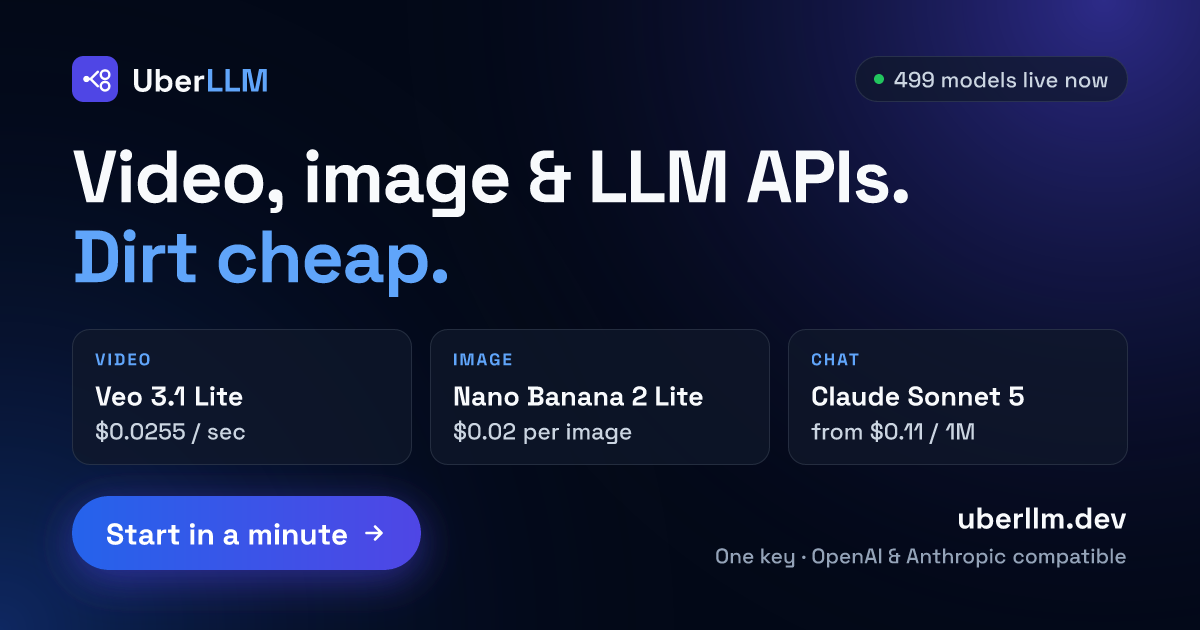
One approach that has gained traction is using a marketplace-style platform that aggregates multiple model providers under a single API key. This is where a service like the uberllm gpt image generation api becomes relevant. It lets you route requests to different models without managing separate accounts or dealing with individual rate limits. But even if you go that route, you still need to evaluate the models themselves.
What to Look For in an Image Generation API
Before comparing providers, it helps to break down the core criteria that matter for production use. These are the dimensions that separate a hobbyist setup from something you can rely on in a customer-facing application.
Latency and Throughput
Image generation is computationally expensive. Even the fastest models take a few seconds to produce a single image. If your application expects to generate dozens of images per minute, you need to know the API's throughput ceiling. Some APIs offer batch endpoints that can handle multiple prompts in a single call. Others limit concurrent requests. Check for explicit rate limits and whether the provider supports queuing or async processing.
Also consider the location of the servers. An API hosted far from your user base will add network latency on top of generation time. If speed matters, look for providers with edge regions or CDN-backed delivery.
Output Quality and Consistency
Not all models produce the same level of detail, composition, or adherence to prompts. Some GPT image generation APIs let you specify a model version or style preset. Others automatically route to the best available model based on your prompt. The tradeoff is between control and convenience.
If you need predictable brand-consistent images, you might prefer an API that gives you fine-grained parameters like guidance scale, seed, and negative prompts. If you just need any decent image quickly, a black-box API with smart defaults might serve you better.
Pricing and Scalability
Pricing for image generation APIs varies wildly. Some charge per image, some per megapixel, and some include a fixed monthly fee for a certain number of requests. The cost per image can differ by an order of magnitude depending on the model and provider. For high-volume use, even a small per-image difference adds up fast.
A platform like UberLLM can help here by routing your request to the cheapest available model that meets your quality threshold, potentially reducing costs compared to buying from a single vendor. But you should still understand the base pricing of each model in the marketplace to make informed routing decisions.
Integration and Developer Experience
The quality of the API's documentation, SDKs, and error messages directly affects how fast you can ship. A GPT image generation API with clear examples, a playground, and a consistent response format saves hours of debugging. Look for providers that return structured JSON with image URLs or base64 data, along with metadata like prompt tokens used and generation parameters.
Authentication should be straightforward, usually an API key sent in a header. OAuth is overkill for server-side use. Also check how the provider handles failed generations. Some return partial images or error codes that still count toward your usage. A good API refunds or retries on failure.
Another detail often overlooked is the maximum prompt length and whether the API supports negative prompts or advanced modifiers. If your use case involves generating images for e-commerce or marketing, you might need to specify exact colors, compositions, or text overlays. Not all APIs handle that equally well.
Common Pitfalls and How to Avoid Them
Even a well-chosen GPT image generation API can cause problems if you don't account for a few common issues.
- Prompt engineering mismatch: An API that works with simple prompts may fail when you use complex multi-part instructions. Test with your actual use cases, not just sample prompts from the documentation.
- Inconsistent output dimensions: Some APIs allow arbitrary aspect ratios, others force square images or specific sizes. Define your required dimensions early and verify the API supports them.
- Content filtering overreach: Many providers apply safety filters that can block legitimate prompts. If your domain includes medical or artistic content, test edge cases to see where the filter triggers.
- Lack of fallback: If your primary API goes down or returns errors, do you have a backup? A marketplace approach via the uberllm gpt image generation api can serve as a fallback by routing to an alternative model automatically.
Making the Decision
Start by listing your non-negotiable requirements: supported image sizes, response time budget, maximum monthly volume, and budget per image. Then evaluate a shortlist of providers against those criteria. If possible, run a proof of concept with your actual prompts and measure both the quality and the latency.
For many teams, the flexibility of a multi-model API platform is worth the added complexity of managing routing logic. Platforms like UberLLM simplify that by offering a single endpoint that selects the best model from a pool of providers. That way you don't have to rewrite code every time you switch models or need to scale up.
Ultimately, the right GPT image generation API is the one that delivers acceptable images at a predictable cost with minimal maintenance overhead. Don't over-optimize for a single dimension. A slightly slower API with better uptime and consistent quality will serve you better than one that is fast but flaky.
As the technology evolves, expect more APIs to incorporate real-time feedback loops, where the model iterates on an image based on your edits or preferences. Already, some providers offer inpainting and outpainting endpoints that let you modify specific regions of an image. Those capabilities will become standard soon, so choose a platform that can adopt new model features without requiring you to re-architect your integration.
The UberLLM ecosystem, including the uberllm gpt image generation api, is one example of how the market is moving toward aggregation rather than lock-in. By keeping your options open, you future-proof your application against changes in model quality, pricing, and availability.